29 Sep 2024
Indonesian Language and Literature Education Student Undertakes Industrial Internship at PT Semen Padang
Aisyah Mifti Jannah, an outstanding student from the Indonesian Language and Literature Education Study Program (PBSI), Faculty of Teacher Training and Education (FKIP), Universitas Bung Hatta, class of 2022, has been officially selected to represent the university in the Industrial Internship Program at PT Semen Padang. This program forms an integral part of the Grant for Accelerating Curriculum and Learning Development in Higher Education, supporting the implementation of the Independent Merdeka Campus (Kampus Merdeka Mandiri) in 2024. The initiative is funded by the Ministry of Education, Culture, Research, and Technology (Kemendikbudristek) of the Republic of Indonesia, under the Directorate General of Higher Education, Research, and Technology (Ditjen Diktiristek).
The Merdeka Belajar–Kampus Merdeka (MBKM) policy is strategically designed to motivate students to master multiple disciplines before entering the professional workforce. In response to the rapid changes in social and cultural dynamics, labor market demands, and technological advancement, student competencies must be comprehensively prepared to adapt to the evolving needs of the modern era. The MBKM policy provides a holistic framework to address these challenges, aiming to produce graduates who are not only intellectually capable but also professionally and practically prepared to meet industrial expectations.
The Merdeka Campus represents a model of higher education that is autonomous and flexible, fostering an innovative and student-centered learning culture. This approach grants universities the academic freedom and responsibility to design curricula that are relevant, adaptive, and responsive to societal and industrial transformations.
One of the most tangible implementations of learning outside the university setting is industrial internships or field placements. Historically, students from the PBSI Study Program have had limited exposure to professional industries, with most practical experiences confined to smaller-scale environments such as radio stations. However, opportunities to engage in large-scale industrial or state-owned enterprise (BUMN) internships have remained limited and require more systematic institutional arrangements.
The short-term internship program is conducted over a period of less than six months or up to one academic semester, depending on the agreement between the educational institution and the industrial partner. Throughout the program, students receive intensive supervision and mentorship from assigned academic supervisors to ensure alignment between learning objectives and practical outcomes.
The industrial internship provides students with authentic and contextual field experience, strengthening their professional readiness while broadening their understanding of real-world industrial dynamics. Through hands-on engagement, students are expected to develop comprehensive competencies, making them not only work-ready but also capable of becoming job creators in the future. The program’s primary objective is to offer experiential learning in genuine professional environments.
During the internship period, students acquire valuable hard skills such as technical proficiency, complex problem-solving, and analytical reasoning. Simultaneously, they refine essential soft skills—including professional ethics, effective communication, and teamwork—which are indispensable for success in contemporary workplaces.
This industrial internship establishes a mutually beneficial relationship between academia and industry. On one hand, students gain practical experience, industrial insights, and professional networking opportunities that enhance their employability. On the other hand, industries can identify and engage potential young talents aligned with their organizational needs. Where there is compatibility between student competencies and company requirements, industries may directly recruit these interns—effectively reducing recruitment and onboarding costs.
Students who undergo direct exposure to real work environments emerge with greater confidence and adaptability when entering professional careers. They develop a deeper understanding of corporate culture, business processes, and industrial expectations—key assets for long-term career advancement.
Prior to the internship implementation, a series of preparatory and coordination meetings were held between both parties. The PBSI Study Program was represented by the Person in Charge (PIC), Romi Isnanda, M.Pd., accompanied by Ika Nopikasari, while PT Semen Padang was represented by Zam from the Training and Knowledge Management (KM) Division.
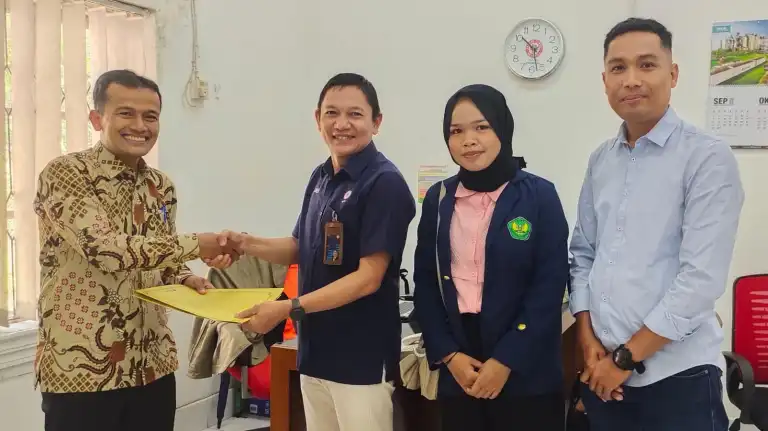
The collaboration was formally realized through an official handover ceremony on Friday, 27 September 2024, attended by Rio Rinaldi, Head of the PBSI Study Program, and Romi Isnanda as the PIC. The program is governed by a formal cooperation agreement signed by both institutions, providing a legal and institutional framework for its execution.
Previously, Universitas Bung Hatta had established a Memorandum of Understanding (MoU) with PT Semen Padang as part of a broader strategic partnership. The implementation of specific collaborative initiatives has since been followed up by individual study programs, with the PBSI Study Program taking the lead in pioneering this industrial internship model.
This strategic collaboration aims not only to enhance the quality and quantity of academia–industry partnerships but also to expand student access to relevant and high-quality professional experiences within the industrial sector. The program stands as a model of Kampus Merdeka implementation that can be replicated by other study programs at Universitas Bung Hatta and higher education institutions nationwide.
Through the synergistic collaboration between Universitas Bung Hatta and PT Semen Padang, a more responsive and integrated educational ecosystem is expected to emerge—one that aligns academic learning with industrial needs. Ultimately, this partnership contributes to producing graduates who are academically excellent, professionally competent, and globally competitive, marking a concrete step toward realizing Indonesia’s vision of higher education that cultivates high-quality, internationally competitive human resources.
News Link : https://fkip.bunghatta.ac.id/berita/mahasiswa-pindo-fkip-magang-industri-ke-pt-semen-padang/
© 2026 SDGs Center Universitas Bung Hatta